
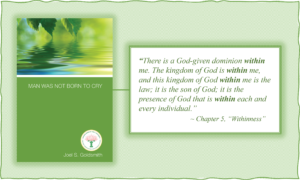
Recording 322B, “Withinness,” is from the 1960 Chicago Class. It is one of two recordings that are the basis for Chapter 5, “Withinness,” in Man Was Not Born to Cry.
To download or print these study suggestions, click/tap here.
Chapter 1: “The Spiritual New Year”
Joel teaches that good wishes or resolutions do not produce a truly spiritual New Year. It comes with a new state of consciousness because our consciousness shapes our experience. We must stop identifying with erroneous beliefs about ourselves and live from the realization of our spiritual identity and the truth of one power, rather than from fear, conditioning, or mass belief. If we do not consciously recognize the truth, we are subject to the world hypnotism, the belief in good and evil. Still, one spiritually awakened consciousness can ultimately bless the world.
Chapter 2: “The One Great Demonstration”
Joel emphasizes the importance of meditation and inner silence in developing spiritual awareness. He addresses a core Infinite Way principle: God constitutes individual being. When we realize this truth, we no longer try to demonstrate things or conditions. We demonstrate the conscious awareness of the presence of God, and then God appears as the fulfillment of the need. The solution to every problem lies in realizing the presence of God within and letting that Presence go before us. There is not God and you; God lives as you—God constitutes your being. When we stand consciously in this truth and allow God to use us, we become beholders, watching God at work.
Chapter 3: “The Truth That Makes Free”
Joel affirms that the realization—not just an intellectual understanding—that God is All is sufficient for our every need. He teaches that when you know the impersonal, universal nature of evil, you see that nothing in you is responsible for your ills. Why? Because God constitutes your identity. Therefore, you cannot have any evil qualities. Any error that finds expression in you has nothing to do with you; all evil stems from a universal, impersonal source and originates in the erroneous belief in two powers. To be free of that belief, you must know that since God did not make the belief in good and evil, it is not God-ordained or God-sustained and has no law of God to perpetuate it. Joel also explains that we can prevent ills from entering our experience by doing “protective work,” which is not trying to protect ourselves from anyone or anything, but refusing to accept erroneous universal beliefs.
Chapter 4: “Christ Raised from the Tomb”
In Chapter 4, Joel teaches that the Messiah, or Christ, is not an external power that changes human conditions, but the divine Presence within every individual consciousness. Therefore, the spiritual path turns us away from the worship of personality and toward discovering the indwelling Presence revealed by the great mystics. This discovery requires a rebirth: the “natural man,” or human sense of selfhood, must die so that the Son of God may be raised up in us. In other words, our human selfhood is the tomb in which the Christ lies hidden. The ultimate function of the Christ is to lift us above dependence on human good into the realization of a spiritual kingdom “not of this world.” Instead of trying to use God to improve our human lives, we allow God to live ITS life AS our individual being.
Chapter 5: “Withinness”
In this chapter, Joel continues on the theme of the previous chapter. He reiterates the Master’s teaching that the kingdom of God is within you and teaches that realizing this truth brings freedom from fear, sin, disease, lack, and limitation. Since God is within us, and God is omnipotent, omnipresent, and omniscient, there can be no power outside of us that can harm us. And since God is not responsible for our troubles, the difficulties of human experience do not arise from external forces but from ignorance of our true spiritual nature and the belief in powers other than God. We can dispel that ignorance by knowing the truth about our identity and our God-given dominion. We can remind ourselves daily that all good is already within us, waiting to be expressed. And we can continually acknowledge God’s presence, not only in ourselves, but in everyone we meet.
This chapter reflects the book’s theme, “Man Was Not Born to Cry,” which declares the spiritual truth that man was not born to live in fear, lack, disease, or limitation, and need not suffer. In this chapter, Joel teaches that we suffer because we are, to some degree, spiritually ignorant and mistakenly believe external circumstances or people have power over us. He teaches us how to dispel that ignorance and free ourselves from suffering.
Recording 322B, “Withinness,” is from the 1960 Chicago Open Class. It is the basis for Chapter 5, which is largely an edited transcript of the recording.
The chapter includes a story about a faithful church-going man who sought healing but had not received it. When he came to Joel, Joel asked him why he went to church, and the conversation led to the idea that the man might go to church to give, rather than to get. This story does not appear in recording 322B. It comes from recording 322A, and Joel uses it to illustrate that the bread we cast upon the waters returns to us.
These suggested practices can help reinforce the lessons and principles highlighted in this chapter. We recommend you choose one or two, rather than try to do all of them.
1. Use one of the study methods suggested for the previous chapters.
If you used either of the study methods we suggested for the three previous chapters and found them helpful, you can apply that study method to this chapter. While we have not provided the study pages as we did for the previous chapters, you can still apply the methods, which we review below.
Method 1: Study one chapter section each day
Instead of reading the entire chapter at once, read one section each day and focus only on that section. Conveniently, this chapter has seven sections, one for each day of the week. (To read the quote from Joel that supports and encourages this approach, click/tap here.)
Our study book comprises the 1962 Infinite Way Monthly Letters. Joel often said that a Monthly Letter was an “outline for study and practice,” and that students should learn to “pick out the pearls, apply them, use them, and live with them.” Studying the chapter section by section lets us follow Joel’s direction and move beyond merely reading the chapter to letting its message take root in our consciousness.
For each section:
Method 2: “Translate” the chapter into your own words.
With this study method, you “translate” the chapter into your own words. This does not mean that you should alter Joel’s principles or substitute your personal opinions for them. Simply ponder the meaning of the words and then, in your own words, write what you understand each paragraph to be saying. Make notes about questions that arise, or about anything that comes to you that deepens or enhances your understanding. (To read the quote from Joel that supports and encourages this approach, click/tap here.)
As you work with this method, take a moment before you begin to pray for light, discernment, and understanding, and when you finish, allow time to be still and listen, receptive to whatever may unfold from within.
2. Questions for Contemplation
These questions invite you to ponder some of the key points in the chapter. If you find that referring to the chapter does not provide the clarity you want, you may wish to explore the points further using the Electronic Search Tool.
What makes us vulnerable to these appearances, and how can we be set free from them?
What does “God-given dominion” mean? Do I understand how to exercise this dominion, and am I exercising it? If not, what is preventing me from doing so?
Joel tells us to carry love, friendship, forgiveness, understanding, and spiritual recognition wherever we go, and to let these flow forth to others. To what extent do I practice this in my daily life?
What spiritual principle is the basis for this instruction?
3. Practice “Withinness” – Sit in Stillness
In “Across the Desk” at the end of this chapter, Joel says:
“To understand the nature of God is the great secret. . . . Only through prayer and meditation is the activity of the presence of God made practical in our daily affairs.. . . Do not feel that you must eternally chase God: rather, be still and let God catch up to you. . . . There is a Christ, and to be still brings the experience of divine grace because of this ever-present spirit of God in man. Be still. There is no need to tell God, to instruct, or to plead with Him. Be still.
“The all-knowing already knows, and the stillness brings the fruitage of God’s knowing. God is love, and that stillness brings the fruitage of God’s love. God’s grace is ever with us, and that stillness reveals the fruitage of God’s grace.”
To practice “withinness,” take some time each day to follow Joel’s direction and simply be still. Be still and listen. If a short contemplation helps you to enter the silence, you might consider one of these if you do not already have one you use regularly:
[1] Based on several excerpts from Joel.
[2] Leave Your Nets, Chapter 5, “Hidden Manna”
[3] 1955 Infinite Way Letters, Chapter 1: “The Importance of Meditation”
[4] Recording 260A: “Treatment and Meditation”
[5] Recording 207A: “Specific Principles of Healing, Including Forgiveness”
[6] The Foundation of Mysticism, Chapter 5, “Transition in Consciousness”