
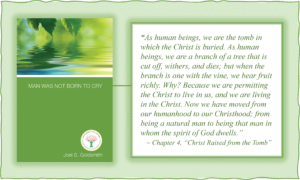
Recording 441B, “Christ Raised from the Tomb,” is from the 1961 Hawaiian Village Open Class. It is the basis for Chapter 4, “Christ Raised from the Tomb,” in Man Was Not Born to Cry.
The Optional Study Suggestions for this chapter are in TWO documents because we used two different page orientations.
PLEASE NOTE: If you print the study suggestions using two-sided printing, note that Part 2 is in landscape orientation. Therefore, be sure the print settings are for “Landscape orientation” and “Flip pages on short edge” so the pages will print properly.
Chapter 1: “The Spiritual New Year”
Joel teaches that good wishes or resolutions do not produce a truly spiritual New Year. It comes with a new state of consciousness because our consciousness shapes our experience. We must stop identifying with erroneous beliefs about ourselves and live from the realization of our spiritual identity and the truth of one power, rather than from fear, conditioning, or mass belief. If we do not consciously recognize the truth, we are subject to the world hypnotism, the belief in good and evil. Still, one spiritually awakened consciousness can ultimately bless the world.
Chapter 2: “The One Great Demonstration”
Joel emphasizes the importance of meditation and inner silence in developing spiritual awareness. He addresses a core Infinite Way principle: God constitutes individual being. When we realize this truth, we no longer try to demonstrate things or conditions. We demonstrate the conscious awareness of the presence of God, and then God appears as the fulfillment of the need. The solution to every problem lies in realizing the presence of God within and letting that Presence go before us. There is not God and you; God lives as you—God constitutes your being. When we stand consciously in this truth and allow God to use us, we become beholders, watching God at work.
Chapter 3: “The Truth That Makes Free”
Joel affirms that the realization—not just an intellectual understanding—that God is All is sufficient for our every need. He teaches that when you know the impersonal, universal nature of evil, you see that nothing in you is responsible for your ills. Why? Because God constitutes your identity. Therefore, you cannot have any evil qualities. Any error that finds expression in you has nothing to do with you; all evil stems from a universal, impersonal source and originates in the erroneous belief in two powers. To be free of that belief, you must know that since God did not make the belief in good and evil, it is not God-ordained or God-sustained and has no law of God to perpetuate it. Joel also explains that we can prevent ills from ever entering our experience by doing “protective work,” in which we do not try to protect ourselves from anyone or anything, but from accepting erroneous universal beliefs.
Chapter 4: “Christ Raised from the Tomb”
In Chapter 4, Joel teaches that the Messiah, or Christ, is not an external power that changes human conditions, but the divine Presence within every individual consciousness. Therefore, the spiritual path turns us away from the worship of personality and toward discovering the indwelling Presence revealed by the great mystics. This discovery requires a rebirth: the “natural man,” or human sense of selfhood, must die so that the Son of God may be raised up in us. In other words, our human selfhood is the tomb in which the Christ lies hidden. At first, the activity of the Christ may appear as improved human harmony, but the ultimate function of the Christ is to lift us above dependence on human good into the realization of a spiritual kingdom “not of this world.” We must surrender personal selfhood to attain the state expressed by Paul: “I live; yet not I, but Christ liveth in me.” Instead of trying to use God to improve our human lives, we allow God to live ITS life AS our individual being.
Recording 441B, “Christ Raised from the Tomb,” is from the 1961 Hawaiian Village Open Class. It is the basis for Chapter 4, which is largely a transcript of the class.
A “Parallel Bible” displays two or more Bible translations side by side in parallel columns on the same page. This enables the reader to consider how a verse or chapter is rendered in different translations and often helps bring its meaning into clearer focus.
In the spirit of a Parallel Bible, we suggest that you “translate” the chapter into your own words. We do not mean that you should alter Joel’s principles, substitute your personal opinions, or do a word-for-word translation. Rather, we mean ponder the chapter sections, seek their meaning, and allow them to be interpreted in your own consciousness. Then write, in your own words, what you understand each paragraph or section to be saying. If questions arise, or if something comes to you that deepens or enhances your understanding, make a note of that as well.
Joel’s own words support this approach. He says:
“These writings are not written in quotable language. In other words, they are written from the standpoint of the way I’m speaking so that you can get the essence of what I’m saying, but you’d have a very difficult time quoting me in exact words because I don’t speak in headlines. I don’t speak in quotable quotes. I don’t speak in the type of language that lends itself to ready quotation. And so, if you are to understand the writings of The Infinite Way, it is necessary that you read them and draw the essence, the meaning of the words from them, rather than learn the words themselves.” (Recording 99A: 1954 Northwest Series – Seattle, “Thy Grace Is My Sufficiency and A Note from Hawaii)
We suggest doing this exercise in small segments, perhaps only one or two sections at a time.
Again, remember that our study book is the collection of the 1962 Infinite Way Letters. Joel said that each Letter was an “outline for study and practice,” and that students should learn to “pick out the pearls, apply them, use them, and live with them.” Studying the chapter in this way gives us an opportunity to follow that direction. Instead of merely reading Joel’s words and moving on, we pause over them, ponder them, draw out their essence, and allow their meaning to take root in consciousness. The purpose is to have the message become our own, so we can live it.
Chapter 4 is reproduced in its entirety in Part 2 of the optional study suggestions. That document has been formatted to provide space for your notes and reflections. The chapter is copyrighted material and is reproduced for nonprofit educational and study purposes in reliance on the fair use provisions of U.S. copyright law.
To access Part 2, click/tap here.