
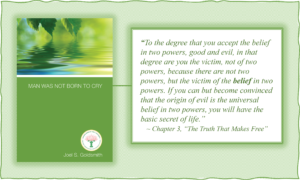
Recording 318B, “Treatment and Law – to Grace,” is from the 1960 Kansas City Practitioner Class. It is the basis for Chapter 3, “The Truth That Makes Free,” in Man Was Not Born to Cry.
To download or print these study suggestions, click/tap here.
Chapter 1: “The Spiritual New Year”
In Chapter 1, Joel teaches that good wishes or resolutions do not produce a truly spiritual New Year. It comes with a new state of consciousness because our consciousness shapes our experience. We must stop identifying with erroneous beliefs about ourselves and live from the realization of our spiritual identity and the truth of one power, rather than from fear, conditioning, or mass belief. If we do not consciously recognize the truth, we are subject to the world hypnotism, the belief in good and evil. Still, one spiritually awakened consciousness can ultimately bless the world.
Chapter 2: “The One Great Demonstration”
In Chapter 2, Joel emphasized the importance of meditation and inner silence in developing spiritual awareness. He addressed a core Infinite Way principle: God constitutes individual being. When we realize this truth, we no longer try to demonstrate things or conditions. We demonstrate the conscious awareness of the presence of God, and then God appears as the fulfillment of the need. The solution to every problem lies in realizing the presence of God within and letting that Presence go before us. There is not God and you; God lives as you—God constitutes your being. When we stand consciously in the realization of this truth and allow God to use us, we become beholders, watching God at work.
Chapter 3: “The Truth That Makes Free”
In Chapter 3, Joel affirms that the realization—not just an intellectual understanding—that God is All is sufficient for our every need. He goes on to teach that when you understand the impersonal, universal nature of evil, you see that nothing in you is responsible for your ills. Why? Because God constitutes your identity. So you cannot have any evil qualities or propensities. Any error that finds expression in you has absolutely nothing to do with you. All evil stems from a universal, impersonal source, and it originates in the erroneous belief in two powers. To be free of the belief in two powers, you must know the truth: since God did not make the belief in good and evil, it is not God-ordained or God-sustained and has no law of God to perpetuate it.
Joel also explains that we can prevent these ills from ever entering our experience by “protective work,” understanding and applying specific principles. We are not trying to protect ourselves from anyone or anything; we are protecting ourselves from accepting erroneous universal beliefs.
Recording 318B, “Treatment and Law – To Grace,” is the basis for Chapter 3, and Chapter 3 is largely a transcript of the class.
However, in the recording, Joel gives references for study, some of which do not appear in the book.
The following recommendations are given in the recording, but not in the book:
Impersonalization, Nothingization, and Protective Work
You will find that in our current study chapter, Joel addresses impersonalization, nothingization, and protective work in the context of “the truth that makes us free.” Over the course of our study programs, we have worked with all three of these topics. Should you wish to review any of these topics in greater depth, you can refer to our study materials.
Given the positive feedback on the approach we used for studying Chapter 2, we are repeating that approach for Chapter 3. We suggested that rather than reading the entire chapter at once, you take one section each day and focus on that section alone.
To re-read the quote from Joel that supports and encourages this approach, click/tap here.
As you work with this chapter, section by section:
Again, remember that our study book is the collection of the 1962 Infinite Way Letters. Joel said that each Letter was an “outline for study and practice,” and that students should learn to “pick out the pearls, apply them, use them, and live with them.” Studying the chapter section by section gives us an opportunity to follow Joel’s direction and move beyond merely reading the chapter to attentively letting its message take root in consciousness.
Once again, the chapter conveniently has seven sections, providing one section for each day of the week. As we did for Chapter 2, for each section in the chapter, we include a page with a few simple questions to help guide your contemplation, along with space to jot down anything that comes to you. Other questions or ideas for study may arise; follow wherever your contemplation leads.
The downloadable study material for this chapter provides a separate practice page for each of the seven sections in this chapter. If you prefer to work from this webpage, you can follow the same practice each day using the outline below. Take one section of the chapter, read it slowly, and choose a passage that especially speaks to you. Then move through the four steps—Read, Contemplate, Live, and Listen—using the notes function on your device, a journal or a separate piece of paper to record what comes to you. Repeat the same practice with a new section of the chapter each day.
Here is the practice page for the first section, which does not have a heading, but we will call “Introductory Section.” Use the same format for each subsequent section, as you study.
Slowly and thoughtfully, read the section of the chapter titled “Infinity Is the Measure of Our Being” once or twice. Notice a sentence, phrase, or idea that speaks to you and write it down.
My passage for today:
Sit quietly with the passage you chose. Ask:
Now ask: How can I apply this in my life today?
Let go of questions and become still. There is nothing to accomplish. Simply be receptive, with the attitude, “Speak, Father, I’m listening.”
On the seventh day, you might like to do this follow-up: