
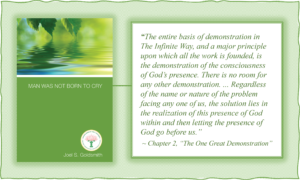
Recording 301A, “Contemplative Meditation on Grace,” is from the 1960 Los Angeles Closed Class. It is the basis for Chapter 2, “The One Great Demonstration,” in Man Was Not Born to Cry.
To download or print these study suggestions, click/tap here.
Review of Previous Chapter
In Chapter 1, Joel taught that good wishes or resolutions do not produce a truly spiritual New Year. It comes with a new state of consciousness because our experience is shaped by what we entertain in our consciousness. We must stop identifying with erroneous beliefs about ourselves and live from the realization of our spiritual identity with God. First, we acknowledge that there is a Presence and Power within, and we live by that. Second, we accept only one power. If we do not consciously recognize this truth, we will be subject to whatever comes from the world hypnotism. Joel explains that one spiritually awakened consciousness can bless families, communities, and ultimately, the world. The real “New Year,” then, begins when we start to live consciously from our true identity, rather than from fear, conditioning, or mass belief.
Chapter 2: “The One Great Demonstration”
In this chapter, Joel begins by emphasizing the importance of meditation and inner silence in developing spiritual awareness. He then addresses a major principle of The Infinite Way: God constitutes individual being. When we realize this truth, we no longer try to demonstrate things or conditions. We demonstrate the conscious awareness of the presence of God, and God then appears as the fulfillment of the need of the moment. The solution to every problem lies in realizing the presence of God within and letting that Presence go before us. There is not God and you; God lives as you—God constitutes your being. When we stand consciously in the realization of this truth and allow God to use us, we become beholders, watching God at work.
The Source Recording
Recording 301A is the basis for Chapter 2, and Chapter 2 is nearly a transcript of the class. There are just a few parts in the recording that are not included in the chapter:
The introductory Section in the Chapter
Joel begins both the class and the chapter with a short reminder about the importance of meditation in developing spiritual awareness. He points out that our spiritual capacity expands only in proportion to our ability to meditate, because spiritual awareness is developed in silence—not in thinking, listening, or reading. Reading and studying are only tools we use to enable us to meditate.
He reminds us that the more often we meditate—not how long, but how many times we meditate during the day and night, even if each time is only a minute or two—the more we develop our spiritual awareness and bring spiritual harmony into our experience.
When our eyes are closed, and we are in the darkness within, we find the entire kingdom of God there, ready to pour itself through our mind, into our body, our home, our business, and our purse. Our attitude is one of receptivity, as though we were inviting God to speak to us or inviting the Spirit to flow through us. Our part is to remember that the kingdom of God, the Allness of God, is within us, and as we are still, the Spirit makes itself manifest in our experience.
This short section is a wonderful reminder of how to meditate, which we can always apply, especially as we study this chapter.
The Remaining Sections of the Chapter
For the remaining sections of the chapter, we offer a different approach to study and practice. Rather than reading the entire chapter at once, we suggest taking one section each day and focusing on that section alone.
Joel supported this method of study. For example, speaking about studying in Chapter 3, “The Secret of the Resurrection,” in The Heart of Mysticism, Volume 6: The 1959 Infinite Way Letters, he says:
“Read slowly, attentively, and ponder at each step the words that are being read, going back again and again, if necessary, because it is not the quantity of material that is read that is the determining factor, but the degree of unfoldment which comes forth from the reading. Often one sentence or one paragraph is sufficient for this purpose. The student should not attempt to see how much material can be read, but rather how much light and how much understanding can be received from each sentence or paragraph that is read. In this way, spiritual discernment is developed.
“Often from such reading one particular statement or passage will stand out above all the others, and as you close your book, you should let this passage remain consciously within you. Ponder it, repeat it, think upon it, because this passage is a seed of truth which is now being planted within you, and then after you have ceased thinking about it, that seed begins to germinate and eventually takes root, later bearing spiritual fruitage in the form of understanding, wisdom, guidance, and the spiritual experience itself.
“Every time you hear a message of truth, whether in lectures, class, or on tape recordings, the word of God is also being planted within you as a seed, or as a dozen seeds, and out of these, even one, springing up into life, will be sufficient for every purpose. Your periods of meditation, in which you contemplate some passage of truth, ponder it, think upon it, and then finally settle into an inner stillness and let the Spirit bear witness with your spirit, also develop your Soul-faculties. . . .
“Always remember that every step of your journey on the spiritual path should be preceded by prayer. Pray for light, for discernment, for judgment, for awakening, and then there will be a message for you in every bit of inspired literature that you read or from every illumined Soul whom you meet.”
So as you work with this chapter, section by section:
Let’s remember that our study book is the collection of the 1962 Infinite Way Letters. Joel said that each Letter was an “outline for study and practice,” and that students should learn to “pick out the pearls, apply them, use them, and live with them.” Studying in this way gives us an opportunity to follow Joel’s direction and move beyond merely reading the chapter to letting its message take root in consciousness.
Conveniently, the chapter has seven sections, providing one section for each day of the week. For each section, we have included a page with a few simple questions to help guide your contemplation, along with space to jot down anything that comes to you. You may find that other questions arise naturally. Follow wherever your contemplation leads.
The downloadable study material provides a separate practice page for each of the seven sections in this chapter. If you prefer to work from this webpage, you can follow the same practice each day using the outline below. Take one section of the chapter, read it slowly, and choose a passage that especially speaks to you. Then move through the four steps—Read, Contemplate, Live, and Listen—using the notes function on your device, a journal or a separate piece of paper to record what comes to you. Repeat the same practice with a new section of the chapter each day.
Here is the practice page for the first section, “Infinity Is the Measure of Our Being.” Use the same format for each section, as you study.
Slowly and thoughtfully, read the section of the chapter titled “Infinity Is the Measure of Our Being” once or twice. Notice a sentence, phrase, or idea that seems to particularly speak to you and write it down.
My passage for today:
Sit quietly with the passage you chose. Ask:
Now ask: How can I apply this in my life today?
Let go of questions and become still. There is nothing to accomplish. Simply be receptive, with the attitude, “Speak, Father, I’m listening.”
On the seventh day, you might like to do this follow-up:
Go back and review the passage you chose for each day.