
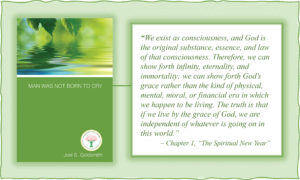
Recording 385A, “Spiritual New Year,” is from the 1960/61 Christmas & New Year’s – Waikiki Class. It is the basis for Chapter 1, “The Spiritual New Year,” in Man Was Not Born to Cry.
To download or print these study suggestions, click/tap here.
The introduction to this book is titled ‘Awake.’ Written by Joel, it presents the spiritual path as an adventure in discovering the Self beyond the body and mind. He tells us that this adventure is worthwhile because it leads to something we all long for: freedom of the Soul from limitation.
In his introduction, Joel gives us a glimpse into the book when he says,
Man was not created to be a slave–physically, economically, or mentally. The purpose of man is to show forth the nature of God. Man originally was intended to be the instrument through which, or as which, God lives on earth. This is the meaning of incarnation–God incarnated as, or in, individual man. The Prodigal symbolizes man’s “lost way” and shows that man can find his way back to “the Father’s house,” to the divine consciousness, and live as the heir of God with the purple robe and the jeweled ring. Man is the great glory of God.
Man was not meant to cry, and all his tears are shed only because of a sense of limitation. Every tear you shed is proof of some form of limitation being experienced in your life. Man was not born to cry! …
You know you have a body, and you know you have a mind, but you have not come to know the you that has the body and the mind. This is the you that is the adventure of life, and the adventure of life is the awakening of this you. You are the Soul that lives. But first you must know the you that is that Soul, and then you must begin to explore, search, and seek until you find Me, until you find your Self, the real you. This is the you that God sent forth to live God’s life on earth, the you that was never born, the you that will never die, the you that for a moment is entombed in a “parenthesis,” struggling to break out so as to live in the full sentence of life. …
Then you will know why it is written: “Weapons reach not the Life; Flame burns it not, waters cannot o’erwhelm,” for you are I, made of the very nature of God—indestructible, indivisible, inseparable from God. Neither life nor death can separate you from life, God, love, fulfillment!
Since Joel wrote this introduction specifically for the book, there is no corresponding source recording. It is, however, a beautiful and inspiring piece in its own right, well worth reading slowly and contemplating.
In the first chapter, Joel teaches that a truly spiritual New Year is not produced by the calendar, good wishes, predictions, or resolutions. It comes with a new state of consciousness. He emphasizes that our experience is shaped by what we entertain in our consciousness, and that spiritual progress comes as we stop identifying with erroneous beliefs about ourselves and live from the realization of our spiritual identity with God.
The key, Joel says, is first to acknowledge that there is a Presence and Power within you and to live by that; and second—equally important—is to accept only one power. Nothing determines what your days ahead will be except your own consciousness, and if you do not consciously recognize the truth, you will be subject to whatever comes from the hypnotism of the belief in good and evil.
Joel explains that this transformation begins with the individual, but he adds that one spiritually awakened consciousness can bless families, communities, and ultimately the world. The real “New Year,” then, begins when we start to live consciously from our true identity, rather than from fear, conditioning, or mass belief.
Recording 385A is the basis for Chapter 1, and Chapter 1 is nearly a transcript of the class. There are just a few parts in the recording that are not included in the chapter: a story about one individual’s efforts to reform a national monetary system, which further illustrates what one individual can do; a commentary on the movement in America toward dependence on government and corporations, illustrating that we must come out from mass consciousness and discover our individual God-given consciousness and capacities; and remarks about some articles in The Reader’s Digest that Joel thought were awakening people to religion as an inner experience, illustrating his point that true religion and spiritual living begin within, in stillness.
Each suggested practice is based on one or more sections of the chapter. These are just suggestions. You may come up with practice ideas that suit you even better.
1. The Power of an Individual
In this section, Joel teaches that change must begin with the individual. As an individual changes, that person can influence others, and that influence can expand to the family, community, nation, and even the world.
2. Consciousness is the Secret / Recognize the Presence Within
Understanding that neither the calendar nor well-intentioned resolutions influence our experience in the New Year—or tomorrow, next week, or next month—what can we do that will affect the future course of our life?
In these two sections of the chapter, Joel repeats a theme we have heard many times: our outer experience is determined by our state of consciousness, by what we are entertaining in consciousness. A consciousness imbued with truth manifests as harmonious outer conditions of life.
Since God constitutes our consciousness, God is the original substance, essence, and law of our consciousness. Therefore, we already have full, complete, perfect spiritual consciousness—but that perfect spiritual consciousness is only demonstrably available in proportion to our awareness of it. Then we can show forth infinity, eternality, and immortality; we can show forth God’s grace rather than the consequences of the era in which we happen to be living.
If we live by the grace of God, we are independent of whatever is going on in this world, and this year—or tomorrow, next week, or next month—can be richer, deeper, more harmonious, and more healthful. But if we go about our daily life with little or no conscious realization of a spiritual presence and power within us, that presence and power will not be demonstrably available, and we are subject to the mass human consciousness. If it happens to be a time of universal prosperity or collective good health, we will probably share in it. But if it happens to be a time of economic depression or epidemics, we will share in that, too.
Joel says that the only way to avoid being part of the mass mind is to begin and end our day, and continue throughout the day, praying without ceasing, recognizing that we ourselves are not living our own life; that God is living it; that there is a divine Presence that goes before us to make the crooked places straight; that there is a spiritual presence and power within us that is the law of resurrection unto our entire experience; that is greater than any problem we face in daily living.
If you would like to explore this practice more deeply, the book Practicing the Presence develops at length the very thing Joel is recommending here: “praying without ceasing” through continuous conscious recognition of God’s presence.
3. Be Ye Therefore Perfect / Individual Responsibility
In these two sections of the chapter, Joel is advocating individual responsibility without self-condemnation. We are responsible for working with the principles and steadfastly accepting truth, but we are not being asked to strive for divine perfection through human will. As Joel says, the only perfection is God’s perfection. Our part is to acknowledge that because God is the source and substance of our being, we can grow into the conscious realization of that perfection. Our life will be subject to God and God’s government in proportion to our conscious acceptance of the truth and our persistence in working with it.
4. Steps in Developing Spiritual Consciousness
The first step in spiritual unfoldment is consciously recognizing and acknowledging the God-presence within. But there is another important step: recognizing that Spirit is the only power, the only law, and the only reality.
Although we are constantly presented with the appearances of material and mental laws, those laws have no power. This realization of spiritual law, or spiritual power, as the only reality is the truth that sets us free from the conditions of “this world.”
These two steps—practicing the presence of God and accepting the truth that there is but one power—will bring greater peace and harmony into our experience. We still carry on our business, profession, or whatever role we have in life, but now this inner life is the consciousness from which we live and conduct all our responsibilities.
Ultimately, we learn that inner contemplation and peace have the power to change the history of the world. Without proselytizing, crusading, or trying to revolutionize religion, politics, or economics, this inner power can reveal new ideas, inventions, and discoveries that must come in order to bring peace on earth.
5. Civilization Is Yet to Be Achieved
Joel says that “civilization” must mean brotherhood, the recognition that spiritually, we are all children of God, spiritual brothers and sisters. Civilization has not come to earth until we love our neighbor as ourselves.
True civilization begins with the individual who is living up to what Jesus described in the Sermon on the Mount,[1] where we leave behind revenge, or the “an eye-for-an-eye and tooth-for-a-tooth” attitude, and move into living by love. Eventually, that individual experience will become the collective experience.
We carry the spiritual presence and power of God wherever we go by our conscious recognition and acknowledgment of it, and in no other way. Only then does the place whereon we stand become holy ground. The inner stillness, peace, quiet, and love that we attain become a spiritual influence felt by all around us. The lack of these is felt as well. So it is important that our life be governed by an inner grace, an inner love for our neighbor, and a greater reliance on the truth that there is but one spiritual power, and that this power is within us, closer than breathing.
[1] In 2021, Goldsmith Global had a study program on The Sermon on the Mount, using Chapters 10-19 of The Thunder of Silence. For a description of the course and access to the study material, click/tap here.